You hear that a major project is coming to your neighborhood, and your first thought might be, “That's probably good for my home's value, right?”
Not necessarily. At least, not right away.
Look at what's happening around Denver. Some neighborhoods are benefiting from major investments that started years ago. Others are still dealing with construction, detours, traffic changes, and the uncertainty of not knowing exactly when the finished project will arrive.
And that timing can make a bigger difference than most homeowners realize.
If you're buying or selling a home near a major Denver development project, it's worth looking beyond the announcement. The more important question is: Where is the project right now, and how long will it take before you actually see the benefit?
Three Denver examples help tell the story: Union Station, the East Colfax project, and Sterling Ranch.
A Development Project Doesn't Help Your Home Value Overnight
It's easy to think of development as a simple equation:
New investment = better neighborhood = higher home values.
Real life is usually more complicated.
A project can eventually make an area more convenient and desirable, but getting there can take years. And during those years, homeowners may experience construction and disruption before they experience the benefits.
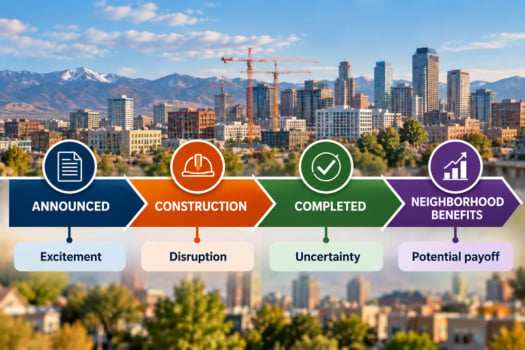
That's why it helps to think about development in stages.
First comes the announcement.
Then comes construction.
And eventually, if everything goes according to plan, the project is completed and the surrounding neighborhood has time to respond.
Your experience as a homeowner can be very different depending on which stage you're in.
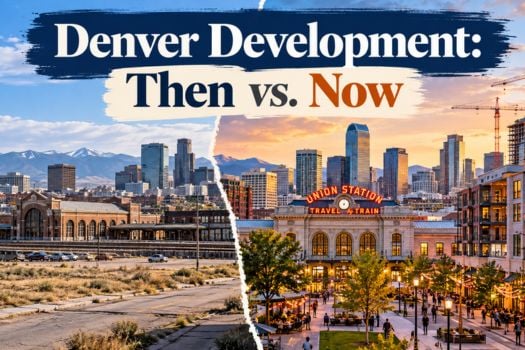
Union Station Shows What the Finished Product Can Look Like
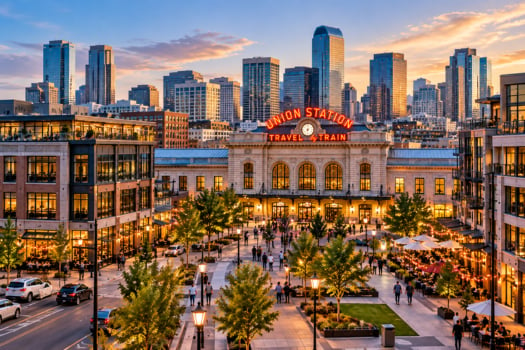
Union Station is a good example because we're able to look at the neighborhood after the major redevelopment has already happened.
Years ago, the area around the station felt very different. The historic terminal was primarily a place to catch a train. Today, Union Station is surrounded by restaurants, shops, hotels, apartments, offices, and other development.
The redevelopment involved roughly $500 million in public investment and helped spark billions of dollars in private development nearby.
The important lesson isn't simply that Union Station became a popular destination.
It's that the benefit took time to develop.
The investment didn't transform everything overnight. The neighborhood continued changing years after the original redevelopment.
That's something homeowners should keep in mind when they hear about a new project coming to their area.
The announcement is only the beginning of the story.
East Colfax Is a Very Different Story—Because It's Still Being Built
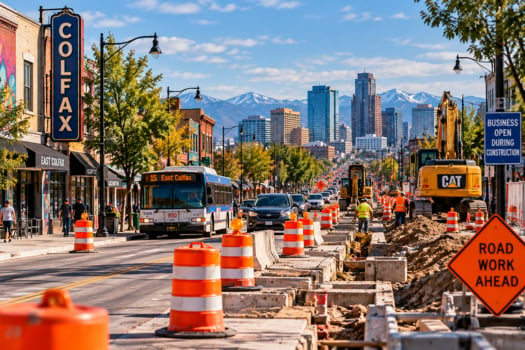
Now compare Union Station with the East Colfax project.
The project will improve transit along roughly 10 miles between Union Station and Aurora, with dedicated bus lanes and other improvements designed to make the trip faster and more reliable.
The long-term goal sounds appealing.
But if you live along the corridor today, you're experiencing something very different.
There is utility work, drainage work, paving, construction, and changing traffic patterns. Some portions are expected to reopen before the entire project is finished, while full service is currently expected later. The timeline has already shifted once.
That's the tricky part of buying or selling near a major project.
The future may be better than the present.
A buyer might be excited about having improved transit nearby someday. But when they're touring your home today, they're also seeing the construction, detours, and inconvenience happening outside your front door.
That can affect how they perceive the property—and how much they're willing to pay.
Sterling Ranch Shows Another Side of the Equation
Sterling Ranch is different again.
Here, you're not simply buying near a project. You're buying into a community that is still being built.
There are already homes, trails, open space, and community amenities. But other parts of the original vision are still developing.
Retail and everyday conveniences haven't necessarily kept pace with the housing, so residents may still need to leave the community for groceries, restaurants, coffee, or other errands.
That doesn't automatically make Sterling Ranch a bad place to buy.
It simply means buyers need to understand what they're actually purchasing.
You're buying the home as it exists today, while also betting that the larger community will continue developing as planned.
That's a very different decision from buying in an established neighborhood.
So, What Does This Mean If You're Buying?
If you're considering a home near a major Denver development project, don't stop at the question, “Is this project going to be good for the neighborhood?”
Ask a few more practical questions:
- What has actually been completed?
- What is still being built?
- How long is construction expected to last?
- What will my daily life look like during construction?
- Which amenities exist today?
- Which ones are still planned?
- Is the project funded and actively moving forward?
- How much competition will I have from nearby new construction?
One particularly important distinction is the difference between something being approved, funded, or under construction.
Those milestones aren't interchangeable. A project can sit at one stage for a long time before moving to the next.
If you're buying because of a future amenity, make sure you understand how much of that future is actually in motion.
What If You're Selling?
This is where the timing of a development project can become even more important.
Imagine two similar homes sitting near each other.
One is a resale.
The other is brand new construction, and the builder is offering financing incentives or a lower interest rate.
Which one looks more attractive to a buyer?
The resale seller may have a perfectly good home, but the builder has something the individual seller usually can't match: financing incentives.
That competition can make resale homes in new construction communities especially difficult to sell.
The transcript gives a real example of this challenge: a resale property struggled to sell while buyers had access to new construction with attractive builder financing.
So if you're selling near new construction, don't just ask what your house is worth in theory.
Ask:
What else is a buyer comparing my home against right now?
That could include the builder's price, incentives, interest rate options, HOA costs, upgrades, and the fact that the competing property is brand new.
Should You Buy Now, Sell Now, or Wait?
There isn't one answer for every Denver property.
Sometimes waiting makes sense because the biggest disruption is temporary and the finished project could improve the neighborhood.
Sometimes selling sooner makes sense because buyers are already discounting the property for construction or because new construction is creating too much competition.
And sometimes buying during the messy stage can create an opportunity if you're comfortable waiting for the long-term benefits.
The key is knowing where the project is on its timeline.
Union Station is an example of what happens after the dust has settled.
East Colfax shows what it's like when the future improvement is still under construction.
Sterling Ranch shows what happens when you're buying into a community that will continue developing for years.
Those are three very different situations.
Don't Make the Decision Based on the Announcement Alone
The biggest mistake is assuming that a major development project automatically means higher home values.
It can help.
It can create short-term challenges.
And sometimes, the benefits may take years to become visible.
For homeowners and buyers, the better question is:
“What does this project mean for this specific property, right now?”
Look at the actual homes selling nearby. Look at the competition. Look at access, construction, HOA costs, incentives, and how buyers are responding to the neighborhood today.
Because two homes can be only a few blocks apart and still have very different real estate stories.
Thinking About Buying or Selling Near a Denver Development Project?
If there's a major project near your home—or a neighborhood you're considering buying into—don't rely only on the headlines or the long-term vision.
The local numbers can tell you much more.
We can help you look at the comparable sales, competing listings, and current conditions around the specific property so you can make a decision based on what's happening today, not just what might happen years from now.