

If you're a Colorado school employee hoping to buy a home but struggling to save enough for a down payment, you may have heard about the CHFA Schools to Home program.
Launched in 2026, the program provides eligible public school employees with down payment and/or closing-cost assistance through a deferred second mortgage, potentially reducing the amount of money needed upfront. But there is an important trade-off: the assistance must eventually be repaid, and the program includes a shared-appreciation component.
So, is CHFA Schools to Home actually a good deal for someone buying a home in Denver?
That depends on your finances, how long you plan to stay, and what you're comfortable giving up in future home appreciation.
Here's what Colorado school employees should know before deciding whether the program makes sense for their home purchase.
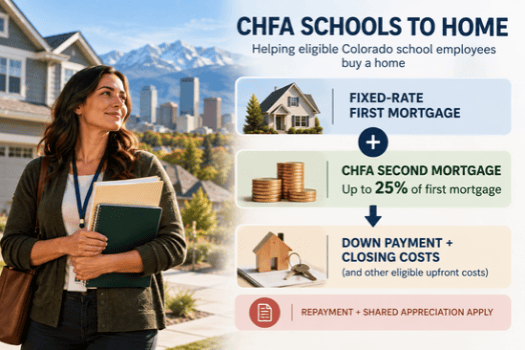
What Is the CHFA Schools to Home Program?
The CHFA Schools to Home program is a Colorado homeownership program designed to help eligible public school employees purchase a primary residence.
The program combines a fixed-rate first mortgage with a CHFA second mortgage that can provide assistance with down payment, closing costs, and other eligible upfront expenses.
The second mortgage can be up to 25% of the CHFA first mortgage amount. It does not carry interest or require a traditional monthly payment.
That can make a significant difference for buyers who have enough income to qualify for a mortgage but don't have enough cash saved for a large down payment and closing costs.
However, this isn't simply free money.
The second mortgage comes with repayment requirements and a shared-appreciation component, which means you need to understand what happens when you eventually sell, refinance, or otherwise pay off the loan.
Who Can Qualify for CHFA Schools to Home?
The program is specifically designed for qualifying full-time public school employees in Colorado.
Depending on the eligible school or district, this can include more than just classroom teachers. School employees may include roles such as:
- Teachers
- Paraprofessionals
- Administrative staff
- Custodial and operations staff
- Other eligible full-time employees of qualifying public school organizations
Eligible employers can include public school districts, charter schools, BOCES, and other qualifying public-school settings.
The program also has normal mortgage qualification requirements. For example, current CHFA program materials list a minimum decision credit score of 620 for scored borrowers, along with income limits and lender underwriting requirements.
Because program requirements can change, buyers should confirm their eligibility and current loan terms with a CHFA-participating lender before relying on the program for a purchase.
Is CHFA Schools to Home Only for Teachers?
No. One of the important things to understand about Schools to Home is that it is not simply a "teacher mortgage."
Eligibility is based on qualifying employment, so other eligible public school employees may be able to use the program as well.
That means a school employee who doesn't work directly in a classroom shouldn't automatically assume they don't qualify.
At the same time, not every education-related job qualifies. For example, private-school employees and college professors are not automatically included simply because they work in education.
If you're unsure whether your employer and position qualify, it's worth asking a participating lender to verify your eligibility before you start shopping for a home.
How Much Can CHFA Schools to Home Help With?
This is where the program can become particularly valuable for buyers who are short on upfront cash.
The CHFA second mortgage can provide assistance of up to 25% of the first mortgage amount.
Importantly, that's based on the mortgage amount—not 25% of the home's purchase price.
For example, if your first mortgage were $500,000, the maximum second-mortgage assistance under the program could be up to $125,000, subject to the program's requirements and your actual qualification.
The assistance can potentially be used toward eligible costs such as:
- Down payment
- Closing costs
- Prepaids and other eligible upfront expenses
The exact amount you receive depends on your loan and financial situation, so the 25% figure should be viewed as a program maximum rather than an amount every buyer will automatically receive.
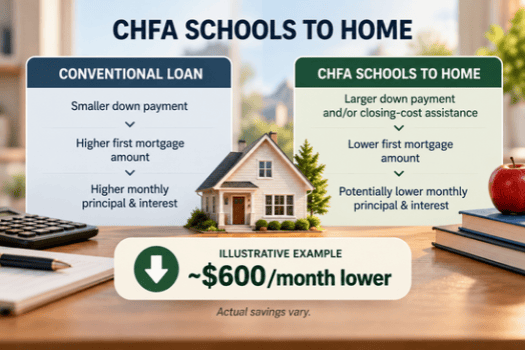
What Could the Monthly Savings Look Like?
Example comparison of monthly mortgage costs with CHFA Schools to Home and conventional financing
The biggest benefit isn't necessarily just having more cash available upfront.
A larger amount of assistance can also reduce the amount you need to borrow through the first mortgage.
For example, a buyer purchasing a home in the Denver metro area in the low-$600,000 range could potentially see a meaningful difference in monthly principal and interest compared with a conventional loan using a smaller down payment, depending on the exact loan structure and interest rate.
In the example discussed for this program, the difference in principal and interest was roughly $600 per month, before considering property taxes, homeowners insurance, HOA dues, closing costs, or future repayment of the second mortgage.
At other price points, the potential monthly difference could be larger.
But these numbers should be treated as examples—not guaranteed savings.
Your actual payment depends on the purchase price, loan amount, interest rate, mortgage insurance, taxes, insurance, HOA costs, and other factors.
That's why a side-by-side comparison using your actual home price and financing scenario is much more useful than simply asking, "How much does the program save?"
The Part You Really Need to Understand: The Money Isn't Simply Free
This is the part buyers should understand before getting excited about the size of the assistance.
The CHFA second mortgage is eventually repaid.
Depending on the circumstances, repayment can occur when the first mortgage is paid off, when the home is sold or refinanced, or when other program-defined events occur.
And there is another consideration:
You may have to share a portion of your home's appreciation with the program.
This is known as shared appreciation.
In other words, you're receiving substantial assistance today in exchange for agreeing to certain financial obligations in the future.
That's why the right question isn't simply:
"How much money can I get?"
A better question is:
"What am I giving up in exchange for getting this assistance now?"
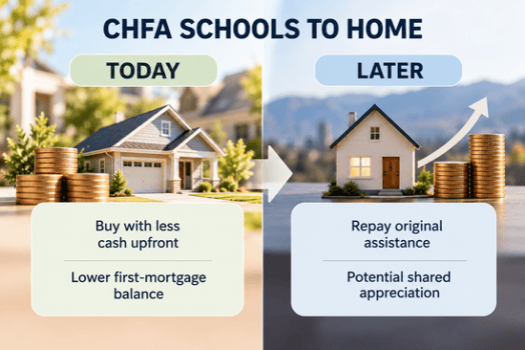
What Happens to Your Home's Appreciation?
CHFA Schools to Home trade-off between upfront assistance and future shared appreciation
Imagine you purchase a home and, several years later, its value has increased.
Under the shared-appreciation structure, a portion of that increase may be owed to the program in addition to repayment of the original assistance.
For example, if a home appreciates by $42,500, a portion of that appreciation could be shared with CHFA based on the terms of the program.
The exact calculation depends on your specific loan documents and program requirements, so buyers should not assume that they will keep 100% of their future appreciation.
On the other hand, if the home's value decreases, the appreciation component may be affected because there is no appreciation to share.
However, that does not mean the original assistance disappears. The second mortgage itself still has to be addressed according to the program's repayment terms.
Is CHFA Schools to Home Worth It?
There isn't one answer for every buyer.
For some Colorado school employees, the program could make homeownership possible much sooner than saving a large down payment independently.
For others, the long-term cost of sharing future appreciation may make a conventional loan more attractive.
The right choice depends heavily on your situation.
Schools to Home may be worth considering if:
- You have stable qualifying school employment.
- You have enough income to qualify for a mortgage but limited savings.
- Saving a larger down payment would delay your home purchase significantly.
- Lowering your first-mortgage balance would meaningfully improve your monthly payment.
- You expect to stay in the home for a relatively long period.
- You're comfortable with the program's repayment and shared-appreciation terms.
A conventional loan may be worth comparing if:
- You already have substantial savings available for a down payment.
- You expect to move within a few years.
- You expect to refinance relatively soon.
- You strongly want to keep all of your future home appreciation.
- The long-term cost of the shared-appreciation component outweighs the benefit of receiving assistance now.
The key trade-off is fairly simple:
Schools to Home can help you own sooner, but you need to be comfortable with the financial obligations that come with that assistance.
What If You Plan to Move or Refinance?
This is one of the most important questions to ask before using the program.
If you think you may sell the home or refinance in two or three years, you should understand exactly what happens to the second mortgage and any applicable shared-appreciation obligation.
A program that looks extremely attractive when you're buying your first home may look different if your expected ownership period is short.
Before closing, ask your lender to walk you through a few scenarios:
What happens if I sell in three years?
What happens if I refinance in five years?
What happens if my home appreciates significantly?
What happens if my home value decreases?
Understanding these scenarios can help you determine whether the upfront assistance is worth the long-term obligation.
Can You Use CHFA Schools to Home to Buy a Home in Denver?
Yes, the program is a Colorado program and can be relevant to eligible buyers purchasing homes in the Denver area.
For Denver-area school employees, that makes the program especially worth understanding.
Home prices in the Denver metro area can make saving a large down payment challenging, even for buyers with stable incomes.
The ability to reduce the amount of cash needed upfront could help some eligible school employees enter the market sooner.
But Denver buyers should still compare the program against other available financing options.
A lower upfront cost does not automatically mean a lower total cost of homeownership.
Five Questions to Ask Before Using Schools to Home
Before deciding whether this program is right for you, ask:
1. How much assistance would I actually receive?
Don't base your decision on the "up to 25%" figure alone. Ask your lender to calculate the actual assistance based on your purchase price and loan amount.
2. How much would my monthly payment change?
Compare the Schools to Home loan with at least one conventional financing option using the same home price and realistic assumptions.
3. How much would I potentially owe when I sell or refinance?
Ask your lender to explain both the original second-mortgage balance and the potential shared-appreciation obligation.
4. How long do I realistically expect to stay in the home?
Your expected ownership period can have a major impact on whether the program makes sense for you.
5. What am I giving up in exchange for the upfront assistance?
This may be the most important question of all.
The goal isn't simply to find the program offering the most assistance.
The goal is to find the financing structure that makes sense for your financial situation and long-term plans.
The Bottom Line for Colorado School Employees
The CHFA Schools to Home program could be a valuable option for eligible Colorado public school employees who want to buy a home but don't have enough cash saved for a traditional down payment and closing costs.
The program can provide substantial assistance and potentially reduce the amount borrowed through the first mortgage.
But there is a trade-off.
The assistance must eventually be repaid, and the shared-appreciation structure means you may give up a portion of future home appreciation.
So if you're a school employee considering buying a home in Denver, don't ask only:
"How much can this program give me?"
Also ask:
"How does this compare with a conventional loan based on the home I actually want to buy—and how long I expect to own it?"
A side-by-side comparison can help you see the difference between the upfront benefit, monthly payment, future repayment, and potential appreciation you could give up.
If you're considering buying a home in Denver and want to know whether CHFA Schools to Home makes sense for your situation, talk with a participating lender and compare the program using your actual purchase price and financing options before making a decision.